The Chamber opens it doors to Gilles Debuire, Deputy Regional Director for Business France in the Nordic countries.
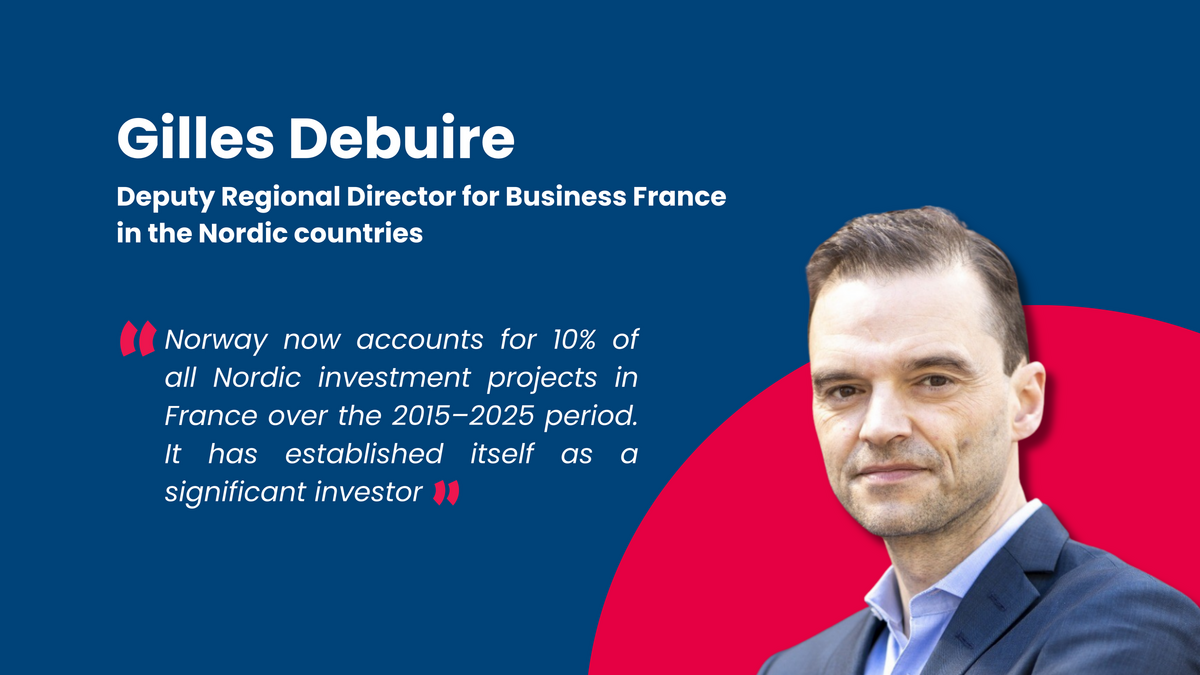
We are delighted to hear from Gilles Debuire, Deputy Regional Director of Business France for the Nordic region, for a discussion focusing on investment trends between France and Norway. With over 25 years’ experience working with Norwegian companies, he shares his insights on recent developments in investment flows and key sectoral trends.
1. Could you briefly share your professional background and what has shaped your current vision of the Nordic region?
I currently serve as Deputy Regional Director for Business France in the Nordic countries, where I oversee and coordinate all matters related to investment and France’s international attractiveness. In this role, I work closely with my colleague Isabella Spove, based in Stockholm and responsible for Swedish and Norwegian companies, as well as Jean-Nicodème de Roquefeuil, based in Paris, who covers the broader Nordic region from France.
To recall, Business France is the national agency supporting the international development of French companies, promoting France’s attractiveness, facilitating foreign investment projects, and managing the entire VIE program — a key tool that enables companies to expand internationally by sending young talents on assignments abroad.
Before taking up my current position, I spent many years heading the Invest in France office for the Nordic countries, where I was already in charge on investment and attractiveness topics. That office merged with Ubifrance in 2015 to create Business France. Altogether, I have been working with Norwegian companies for more than 25 years — from major groups to innovative SMEs and fast growing companies looking to expand or invest in France — in close collaboration with both Embassies and the full Team France Norway ecosystem.
This long-term experience has shaped my understanding of the Nordic region — and Norway in particular. Over the years, I have been able to observe and support the dynamism of Norwegian firms in France, long enough to see first-hand their evolution, and sectoral transitions.
2. How have Nordic investments in France evolved over the past decade, and what key trends are you observing today?
In particular, how do you assess the trajectory of Norwegian investments in France in recent years?
Over the past decade, we have seen a steady growth and diversification of Nordic investment in France, with a very clear shift toward more technology driven projects and stronger alignment with the energy transition. In Norway’s case, this trend is twofold: long standing industrial players continue to operate in France—with some adjustments—and new entrants, particularly in digital and innovative services, are significantly reshaping Norway’s footprint in the French market.
Looking at the stock of investment, the Norwegian economic presence in France has grown, but more importantly, it has evolved in qualitative terms. The number of employees working in France for Norwegian owned companies increased from around 6,700 ten years ago to 8,700 last year—a rise of roughly 28%. This growth is driven mainly by new technological players, while traditional industrial sectors have remained broadly stable. Today, close to 90% of Norway linked jobs in France are concentrated in industry (around 53%) and digital activities (around 35%), illustrating this “industrial foundation + tech wave” combination.
If we examine the flow of investments—meaning job creating projects in France between 2015 and 2025—the momentum is clearly upward: 100 projects over the period, generating around 2,000 jobs.
After a relatively steady phase in the mid 2010s (5 to 7 projects per year), Norwegian investment accelerated sharply in the post Covid years, peaking at 16 projects in 2023 and followed by 14 projects in 2024. Job creation has also strengthened in recent years: 2024 stands out as a record year with nearly 300 jobs created. While 2025 shows a slight decline (10 investment decisions for 150 jobs), the overall level remains significantly higher than at the beginning of the period.
We are also seeing a broader sectoral mix, even if this diversification is not yet fully reflected in the stock of investments. A particularly notable trend is the rise of the energy transition segment. A number of green tech projects—almost non existent ten years ago—are now emerging, led by Norwegian companies positioned along new and rapidly developing value chains. This highlights Norway’s strong expertise in this domain and its growing interest in France as a strategic market for these technologies.
Finally, within the broader Nordic landscape, Norway now accounts for 10% of all Nordic investment projects in France over the 2015–2025 period. It has established itself as a significant investor—behind Sweden and Denmark, but ahead of Finland. The recent trajectory of Norwegian investments in France is clearly positive: more projects, greater diversity, and a stronger alignment with today’s strategic priorities—decarbonisation, digitalisation, and innovation.
3. Where do you currently see the most compelling opportunities for Nordic companies to invest in France? Which sectors and ecosystems (for example innovation hubs such as Paris Saclay) should be particularly on their radar?
Today, the most attractive investment opportunities for Nordic companies in France are clearly concentrated in sectors linked to the energy transition, digital technologies, and advanced industrial tech. We are seeing the rapid emergence of a “green tech” segment that was still marginal ten years ago, now driven by Norwegian players in areas such as electric vehicle charging, battery recycling, and low carbon technologies.
The digital sector also represents a major field of investment: it already accounts for 35% of Norway linked jobs in France and continues to attract new projects. This momentum is reinforced by the strength of the French tech ecosystem, particularly in AI, deeptech, and cybersecurity.
Innovation hubs naturally serve as strong entry points for Nordic companies. Paris Saclay, for instance, offers a world class research and technology environment ideal for projects in AI, clean energy, and deeptech. Other industrial regions — Hauts de France, Auvergne Rhône Alpes, and Grand Est — provide attractive conditions for activities related to materials, chemicals, batteries, and low carbon industries.
Overall, the recent trajectory is very positive: Norwegian investment in France has intensified, diversified, and increasingly aligned with France’s strategic priorities — decarbonisation, digitalisation, and innovation. These areas now represent the most compelling opportunities for Nordic companies looking to expand in the French market.
4. How do you see the cooperation between Business France and the French‑Norwegian Chamber of Commerce evolving on the investment agenda? What concrete joint initiatives could further accelerate Norwegian investment flows into France in the coming years?
I see cooperation between Business France and the French‑Norwegian Chamber of Commerce (CCFN) strengthening even further, building on what is already a highly structured and effective relationship. The CCFN is a cornerstone of the Team France Export framework in Norway and also plays a key role in the investment and attractiveness agenda, providing complementary expertise—particularly in helping Norwegian companies identify the right partners in France. This cooperation is embedded in a dense and well‑coordinated Team France Norway ecosystem, working closely with Innovation Norway, the Embassies of both countries, and the economic departments.
We also benefit from a particularly favorable political and operational context, reinforced by two recent milestones. First, the Franco‑Norwegian Strategic Partnership on Green Industrial Transformation, signed in Paris in January 2024, which explicitly aims to boost investment, innovation and R&D between our two countries, supported by joint roadmaps and working groups on CCS, renewable energies and critical raw materials.
Then, the Strategic Partnership signed in Oslo in June 2025 during President Macron’s State Visit, which further expands the scope of cooperation (green transition, advanced technologies, competitiveness, research) and sends a strong political signal to investors.
In practical terms, several operational avenues could reinforce cooperation between Business France and the CCFN. These include scaling up joint sector‑focused missions aligned with strategic priorities—energy transition, renewables, critical raw materials—as well as developing more targeted matchmaking actions. We can also build on existing flagship events, particularly the Green Industry Forum, to be held next March in Paris, which has become a key gathering for mobilising industrial stakeholders and investors.
Cooperation can also leverage the strong growth of the V.I.E program in Norway, which now counts more than 75 young professionals on assignment. The V.I.E scheme is already a powerful tool supporting the expansion of French companies abroad, but it could be increasingly used by Norwegian firms as well—whether to test international markets, explore opportunities for establishing operations, or structure industrial partnerships.
The frameworks established in Paris in January 2024 and reinforced in Oslo in June 2025 provide a clear roadmap. The shared objective is straightforward: to make the Franco‑Norwegian ecosystem even more fluid and attractive, in order to multiply investment and establishment projects in France in the years ahead.